Was this the most polluted World Cup ever?
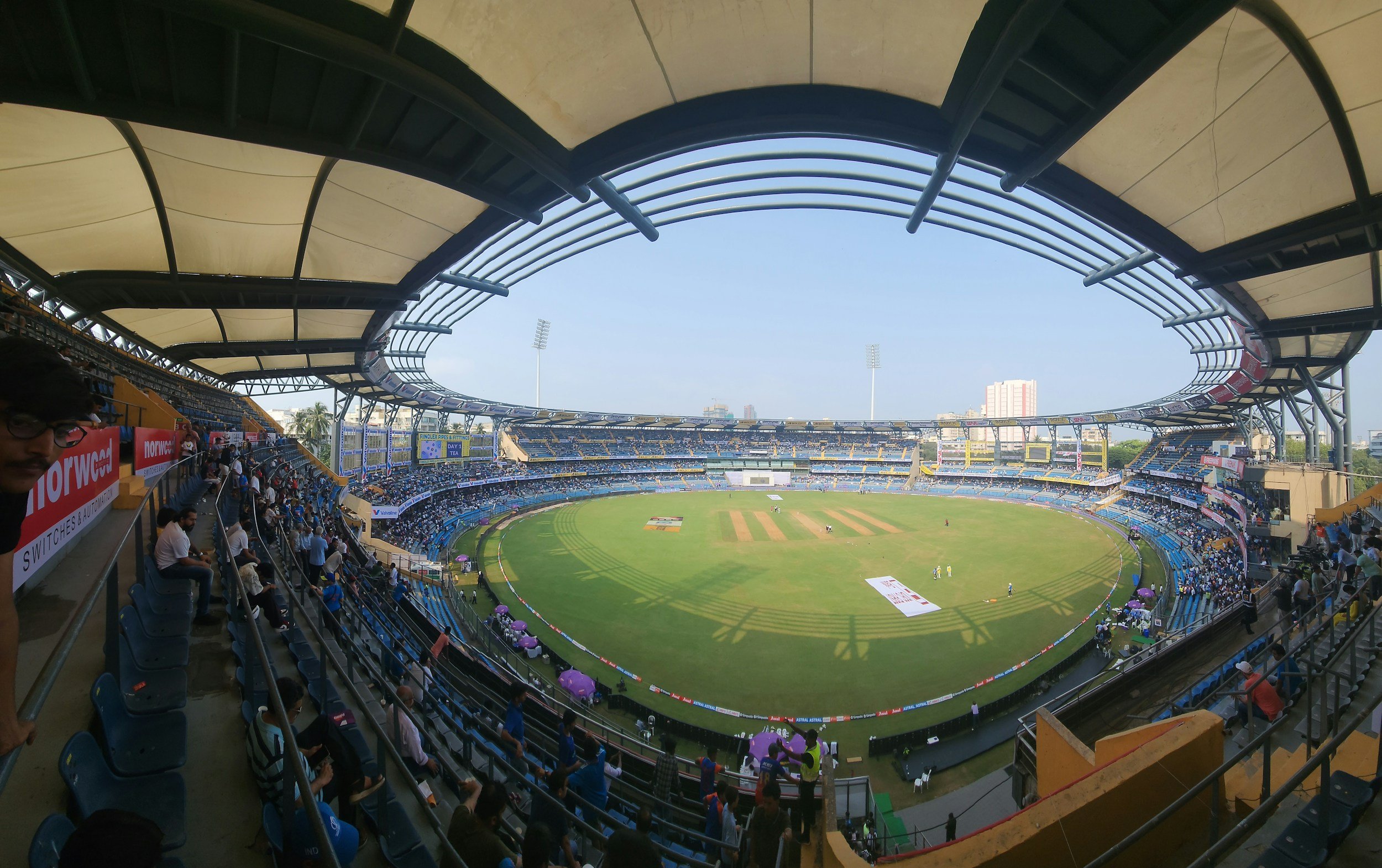
The Wankhede Stadium in Mumbai - one of the worst affected cities
By Chris Britt-Searle
The recent T20 World Cup in India and Sri Lanka could be the most polluted international cricket tournament in history. Analysis carried out by The Next Test shows that almost every game played in the tournament took place in cities with poor, unhealthy, or severely unhealthy air quality.
On the morning of 10th February, ahead of the game between Netherlands and Namibia, the Air Quality Index (AQI) was literally off the scale, with a ‘hazardous’ rating of 316. According to AQI.in, these conditions constitute: ‘dangerously high pollution levels’, with ‘life-threatening health risks.’ By the time the game kicked off, at 11am, the pollution level had dropped to merely ‘severe’, though the advice is still to avoid outdoor activities. The visible smog did not escape online viewers, who took to social media to complain about the hazy picture and point out that India has plenty of other potential venues with lower air pollution.
Just one of the games - England vs. Sri Lanka in Kandy on 22nd February, took place in ‘good’ air quality conditions. Indeed, conditions in Sri Lanka were slightly better than in India - though still not ideal. We’ll delve a bit deeper into the stats in a moment, but first let’s consider why the air quality have been so poor during this tournament.
Why is air pollution so bad in India at this time of year?
The air pollution in India’s major cities is at its worst in the winter months, between October and late February (the World Cup began on 7th February). This is largely due to a ‘temperature inversion’, with cooler air trapping pollutants closer to the ground and causing pollution levels that are sometimes ten times higher than in summer. This is exacerbated by the widespread burning of crop stubble, intense traffic congestion and dust from construction.
This winter has been particularly bad - Delhi experiencing its worst pollution in nearly a decade - sparking protests against the government, who, having pledged to tackle air pollution, have been criticised for not doing enough. Delhi regularly ranks among the most polluted cities in the world - its residents often forced to breathe in toxic air that is comparable to smoking multiple cigarettes daily.
The Breakdown
Delhi, Kolkata and Mumbai
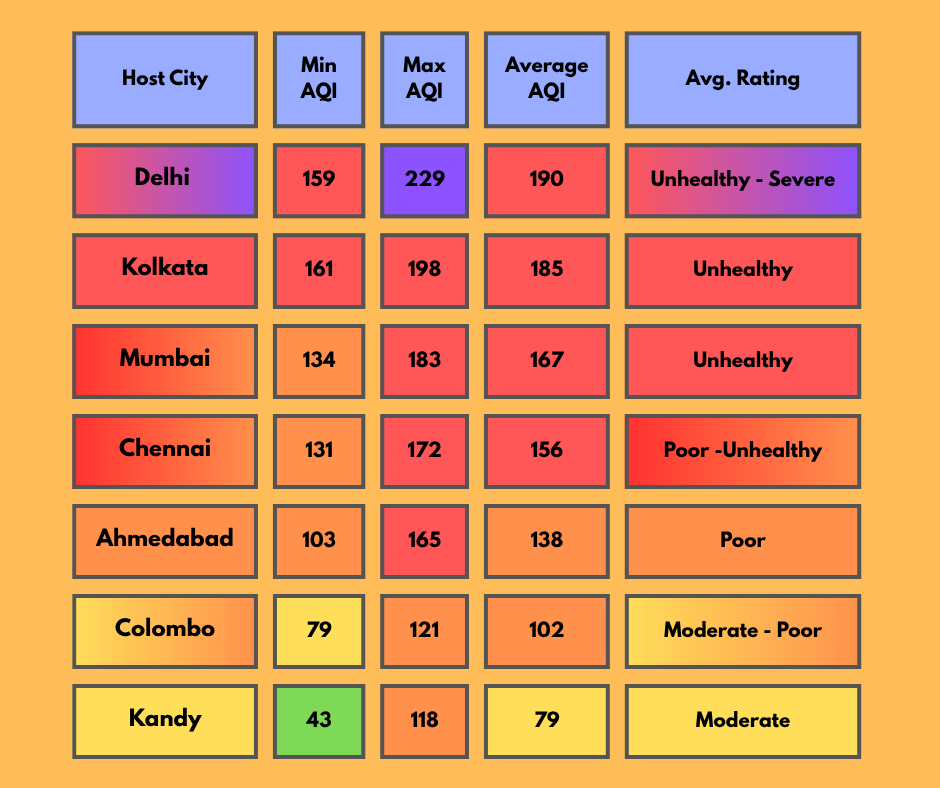
Delhi was particularly bad - and it topped the chart for the worst air quality out of all of the host cities during the World Cup. The lowest AQI rating for Delhi during the tournament was 159 (unhealthy), on 1st March for the Super 8’s match between Zimbabwe and South Africa. Three more of the games were rated ‘unhealthy’, with two played in ‘severe’ conditions, with AQI ratings of 200+. These were the aforementioned match between Netherlands and Namibia and the group D match between Afghanistan and UAE on 16th February. The average AQI for Delhi across the World Cup was 190, giving it an overall rating of ‘unhealthy’ bordering on ‘severe’.
Kolkata wasn’t far behind Delhi. The lowest AQI rating was 161 (unhealthy) for India vs. West Indies on 1st March, while the highest - 198 - occurred on 19th February as the Windies took on Italy. The overall average AQI for Kolkata of 185 was a shade lower than Delhi, giving it a rating for the tournament of ‘unhealthy’.
The average rating for Mumbai was slightly lower at 167, partly due to the semi-final between India and England bringing down the average with a ‘poor’ rating of 134. All of the other games in Mumbai were rated ‘unhealthy’, giving it an overall rating for the tournament of ‘unhealthy’.
Chennai and Ahmedabad
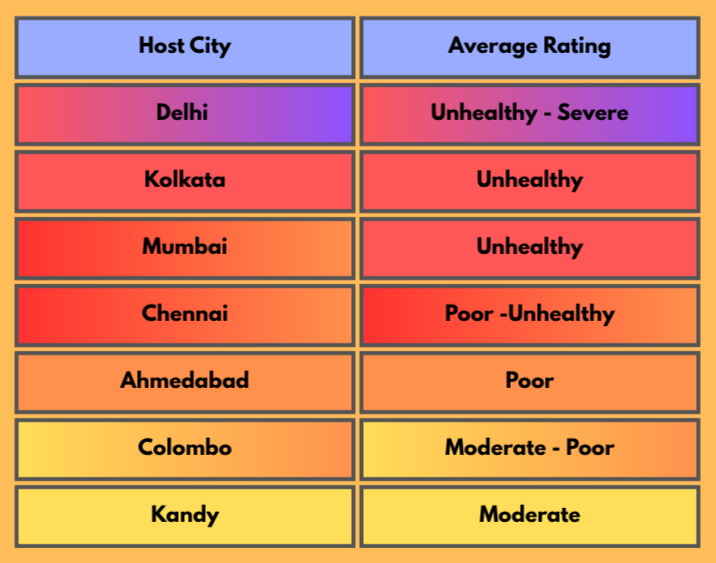
Of the Indian host cities, Chennai and Ahmedabad were the least worst. Both had several matches played in ‘unhealthy’ conditions and the rest were played in ‘poor’.
Colombo and Kandy
Colombo was a mixed bag of ‘poor’ and ‘moderate’ conditions, skewing slightly towards ‘poor’, with a ‘poor’ average rating across all matches of 102. As we’ve mentioned, the only game played in ‘good’ air quality conditions was in Kandy. It did host one match in ‘poor’ conditions - Sri Lanka vs. Australia on 16th February, while the rest were ‘moderate’, giving it a ‘moderate’ average AQI rating of 79 - the lowest of any host city.
In Summary:
““it just felt like you couldn’t get your breath. It was like you were eating the air. It was unique.”
Cricket must get its priorities straight
It is worth pointing out that while India is one of the world’s largest economies (and CO2 emitters), it is still classed as an ‘emerging and developing country’. In an historically unjust world, India is legitimately working to provide a higher standard of living for its citizens. Despite the air pollution issues, India has made impressive advances in renewable energy in recent years. They added a record amount in 2025, reaching almost 50% of their total energy capacity and becoming the world's 4th biggest renewable energy producer. They aim to have installed an incredible 500GW of non-fossil capacity by 2030.
However, we can call into question the ICC’s scheduling, which shows a clear disregard for both player and fan safety. The Indian cricket schedule is understandably packed—limiting the potential timing of such tournaments—but it’s also a country packed with top-notch cricketing venues. It’s not beyond the imagination to think that matches could have been hosted in cities with healthier air quality, especially considering the large numbers of empty seats witnessed at some games.
Similarly, the optics of such a polluted tournament being sponsored by the world’s largest oil company, Aramco—along with other high-polluting sponsors, Emirates, DP World and Hyundai—are not good.
One of the key pillars of the ICC's strategic plan is “protecting the integrity of the sport… inspiring trust among fans… and providing an environment that is safe for all participants.” How can we possibly take this pledge seriously when the world is on fire and the ICC not only turns a blind eye, but actively promotes one of the main fuel sources?
We call on the ICC, along with all National boards and clubs, to heed the recommendation of the ‘Hit for Six’ report and ensure “all commercial partnerships in international cricket… have environmental sustainability at their heart – including sponsorship”.